AI Agents in Manufacturing: Use Cases, Implementation & Cost Guide (2026)
Executive Summary
AI agents in manufacturing help manufacturers connect operational data with decisions and actions across production, maintenance, quality, inventory, scheduling, supply chain, and workforce management. Unlike traditional automation that follows predefined rules or predictive AI that primarily identifies likely outcomes, AI agents can gather context from systems such as MES, ERP, SCADA, CMMS, QMS, WMS, and IoT platforms, reason through operational constraints, recommend next steps, and execute approved actions. Common applications include predictive maintenance, production scheduling, bottleneck detection, quality investigation, yield optimization, inventory management, supplier risk monitoring, and workforce allocation. Manufacturers can begin with a focused workflow, measure impact through KPIs such as OEE, downtime, throughput, FPY, schedule adherence, and inventory turns, and progressively expand agent autonomy as performance and governance are validated.
What are AI Agents in Manufacturing?
An AI agent in manufacturing is software that can observe operational conditions, understand context, reason toward a defined objective, select an action, and execute that action through connected systems within predefined controls.
A traditional analytics system might tell a production manager:
Line 3 cycle time increased by 11% during the last shift.
An AI agent can investigate the underlying context:
Cycle time increased after Tool 7 was installed. Similar tool changes have previously produced comparable cycle-time increases. Line 3 is currently running a high-priority order, while Line 2 has available capacity.
It can then recommend:
Move the next batch to Line 2, inspect Tool 7 during the next maintenance window, and update the production schedule.
The Basic AI Agent Workflow in Manufacturing Operations
With the appropriate permissions, the agent can execute those actions through connected systems.
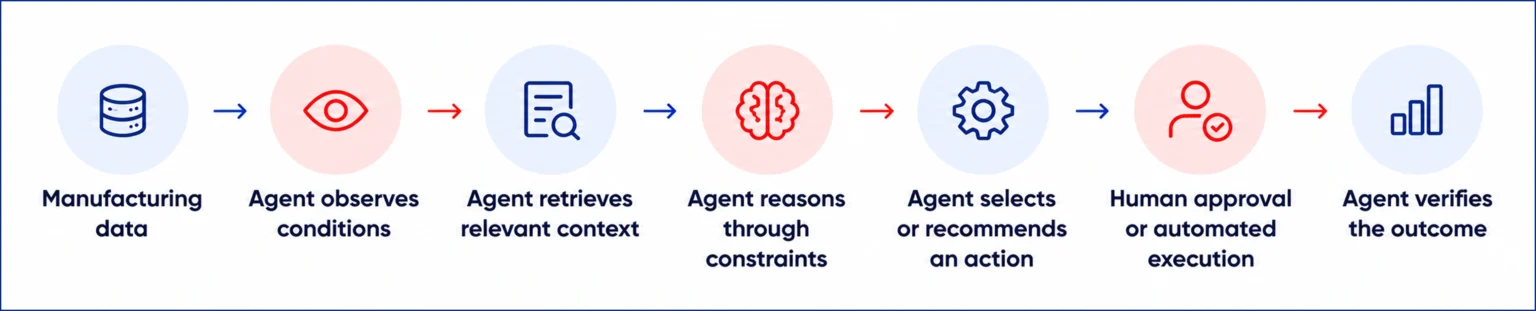
This model is particularly useful for manufacturing because operational decisions frequently involve several systems at once.
AI Agents for Manufacturing Operations: Where Do They Fit?
The strongest AI agent opportunities usually have five characteristics:
→ A recurring operational decision
→ Data available across one or more manufacturing systems
→ Multiple variables or constraints to evaluate
→ A measurable business outcome
→ A defined action that follows the decision
Here is how AI agents can fit across manufacturing operations:
| Manufacturing Operation | Operational Problem | What the AI Agent Does | Systems Involved | Primary KPI |
|---|---|---|---|---|
| Production scheduling | Machine downtime or rush orders disrupt schedules | Recalculates production sequence based on constraints | MES, ERP, APS | Schedule adherence |
| Maintenance | Equipment failures create unplanned downtime | Prioritizes maintenance and recommends intervention timing | IoT, SCADA, CMMS, MES | Downtime, MTBF |
| Quality | Defects require investigation across multiple data sources | Correlates process, machine, and material data | QMS, MES, ERP | FPY, scrap |
| Shop-floor operations | Bottlenecks emerge during production | Identifies constraints and recommends corrective actions | MES, SCADA | OEE, throughput |
| Inventory | Material shortages interrupt production | Monitors consumption, lead times, and stock levels | ERP, WMS, MES | Stockouts, inventory turns |
| Supply chain | Supplier delays affect production | Assesses disruption risk and recommends alternatives | ERP, SRM, TMS | On-time delivery |
| Workforce | Skill and staffing gaps affect output | Matches operators with production requirements | WFM, HR, MES | Labor utilization |
| Energy | Peak demand increases operating costs | Coordinates production with energy conditions | EMS, SCADA, MES | Energy/unit |
| Compliance | Production records are spread across systems | Collects and validates required information | MES, QMS, ERP | Audit preparation time |
The key consideration is workflow connectivity.
A predictive model may identify a high probability of equipment failure. A scheduling system may calculate an alternative production sequence. A CMMS may manage the maintenance task.
An AI agent for manufacturing can coordinate these steps as one operational workflow.
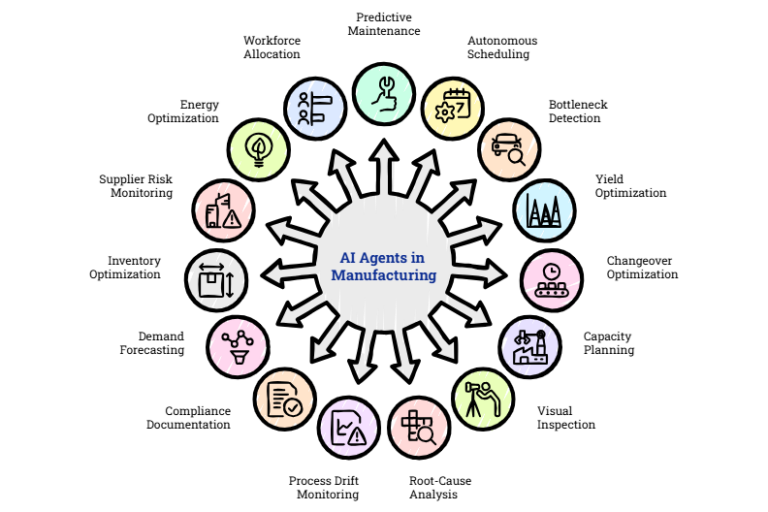
15 High-Impact Use Cases of AI Agents in Manufacturing
Explore how these AI agents are really making a difference on the manufacturing operations.
1. Predictive Maintenance Agent
Problem: Unexpected equipment failures disrupt production and create emergency maintenance work.
Data used: Vibration, temperature, motor current, runtime, maintenance history, alarms, equipment utilization, and production schedules.
Agent decision: Determine which assets require attention and prioritize maintenance according to failure risk and production impact.
Action: Create or recommend a CMMS work order, identify required parts and technicians, and recommend a maintenance window.
KPIs: Unplanned downtime, MTBF, maintenance cost, OEE.
Know how manufacturing companies are using AI predictive maintenance.
2. Production Scheduling Agent
Problem: Production schedules change when machines go offline, materials arrive late, rush orders appear, or labor availability changes.
Data used: Customer orders, WIP, machine capacity, material availability, labor availability, setup times, changeover requirements, and delivery commitments.
Agent decision: Determine the best production sequence while respecting capacity and operational constraints.
Action: Recommend or update production sequences in MES or APS.
KPIs: Schedule adherence, throughput, changeover time, on-time delivery.
3. Bottleneck Detection Agent
Problem: Production constraints move as product mix, staffing, machine conditions, and WIP change.
Data used: Cycle time, takt time, queue length, WIP, downtime, utilization, and production rates.
Agent decision: Identify the active constraint and determine which intervention could improve flow.
Action: Alert supervisors and recommend line balancing, sequencing, resource allocation, or maintenance intervention.
KPIs: Throughput, OEE, WIP, cycle time.
4. Yield Optimization Agent
Problem: Process variation, material differences, and equipment conditions can increase scrap and reduce yield.
Data used: Process parameters, material lots, environmental conditions, inspection results, defect records, and historical production runs.
Agent decision: Identify combinations associated with yield loss and determine which variables require investigation.
Action: Recommend parameter adjustments, trigger additional inspection, or escalate affected batches.
KPIs: First-pass yield, scrap rate, rework rate, cost per unit.
5. Changeover Optimization Agent
Problem: Frequent SKU changes consume production capacity.
Data used: Historical setup times, product sequence, tooling requirements, cleaning requirements, machine configuration, and operator availability.
Agent decision: Select sequences that reduce unnecessary setup, cleaning, tooling, and configuration changes.
Action: Recommend production sequences and generate changeover instructions.
KPIs: Changeover time, available production hours, OEE, throughput.
6. Quality Investigation Agent
Problem: Quality investigations can require information from production, machine, material, inspection, and maintenance records.
Data used: QMS records, MES production history, machine parameters, material lots, inspection results, maintenance records, and operator information.
Agent decision: Identify correlations between process conditions and defect patterns.
Action: Prepare a root-cause investigation, identify affected batches, recommend containment actions, and escalate issues requiring human review.
KPIs: Defect rate, FPY, scrap, rework, investigation time.
Learn how to use AI for Manufacturing Quality Control.
7. Production Performance Agent
Problem: Supervisors spend significant time reviewing dashboards and shift reports to identify production losses.
Data used: Production counts, downtime events, cycle times, OEE components, operator reports, and quality results.
Agent decision: Determine the largest contributors to production loss during a shift or production run.
Action: Generate a prioritized shift summary and recommend corrective actions.
KPIs: OEE, throughput, downtime, schedule adherence.
8. Root-Cause Analysis Agent
Problem: Manufacturing issues frequently involve several interacting variables.
Data used: Machine history, process parameters, production records, quality events, maintenance logs, and environmental data.
Agent decision: Correlate events across systems and rank likely contributing factors.
Action: Generate an investigation path, identify supporting evidence, and recommend the next diagnostic step.
KPIs: Investigation time, recurring defects, downtime, corrective-action time.
9. Capacity Planning Agent
Problem: Capacity decisions affect overtime, production commitments, inventory, and capital requirements.
Data used: Demand forecasts, production capacity, machine utilization, labor availability, maintenance schedules, and historical throughput.
Agent decision: Identify capacity gaps and evaluate scenarios for meeting demand.
Action: Recommend overtime, production redistribution, schedule changes, outsourcing, or additional capacity.
KPIs: Capacity utilization, overtime cost, on-time delivery, throughput.
10. Production Documentation Agent
Problem: Operators and engineers spend time preparing shift summaries, production reports, and operational documentation.
Data used: MES records, machine events, operator logs, quality records, and maintenance activities.
Agent decision: Determine which events require explanation or escalation.
Action: Generate shift reports, summarize deviations, and route exceptions to responsible teams.
KPIs: Reporting time, response time, documentation accuracy.
11. Inventory Optimization Agent
Problem: Excess inventory ties up capital while shortages can stop production.
Data used: Inventory levels, consumption rates, lead times, supplier reliability, production schedules, safety-stock policies, and demand forecasts.
Agent decision: Determine when inventory risk requires action.
Action: Recommend reorder points, safety-stock adjustments, supplier escalation, or production schedule changes.
KPIs: Stockouts, inventory turns, carrying cost, production continuity.
To learn more, read our practical insights on: How to Forecast Demand in Supply Chain
12. Supplier Risk Monitoring Agent
Problem: Supplier delays, quality issues, and logistics disruptions can affect production schedules.
Data used: Purchase orders, supplier delivery history, quality records, shipment status, lead times, and production requirements.
Agent decision: Assess which supplier events could create a production impact.
Action: Escalate high-risk suppliers, recommend alternative sourcing, and update material risk assessments.
KPIs: Supplier OTIF, material availability, production interruptions, expedite costs.
When this intelligence is combined with route optimization software, manufacturers can also reconfigure transportation plans in real time, shortening lead times and reducing the impact of disrupted lanes or carriers.
For more insights, read our article on: Agentic AI in Supply Chain
13. Energy Optimization Agent
Problem: Energy-intensive production can create significant operating costs, particularly during peak demand periods.
Data used: Energy consumption, machine loads, production schedules, utility rates, and operating conditions.
Agent decision: Determine where production timing or load management can reduce energy cost while preserving production requirements.
Action: Recommend production shifts, load balancing, or equipment operating adjustments.
KPIs: Energy/unit, peak demand, energy cost, equipment utilization.
14. Workforce Allocation Agent
Problem: Production performance can suffer when available operators lack the required skills or staffing levels vary by shift.
Data used: Skill matrices, certifications, absenteeism, shift schedules, workstation requirements, and production plans.
Agent decision: Match available personnel with production requirements.
Action: Recommend operator assignments, identify skill gaps, and flag staffing risks before a shift begins.
KPIs: Labor utilization, production output, overtime, training gaps.
15. Maintenance Planning Agent
Problem: Maintenance teams must balance asset condition, production schedules, technician availability, parts, and maintenance priorities.
Data used: Asset health, work orders, production schedules, spare parts, technician skills, and maintenance history.
Agent decision: Prioritize maintenance activities according to equipment risk and production impact.
Action: Build maintenance plans, schedule technicians, reserve parts, and coordinate with production planning.
KPIs: Planned vs. unplanned maintenance, downtime, maintenance backlog, MTTR.
How Does an AI Agent Work Inside a Manufacturing Plant?
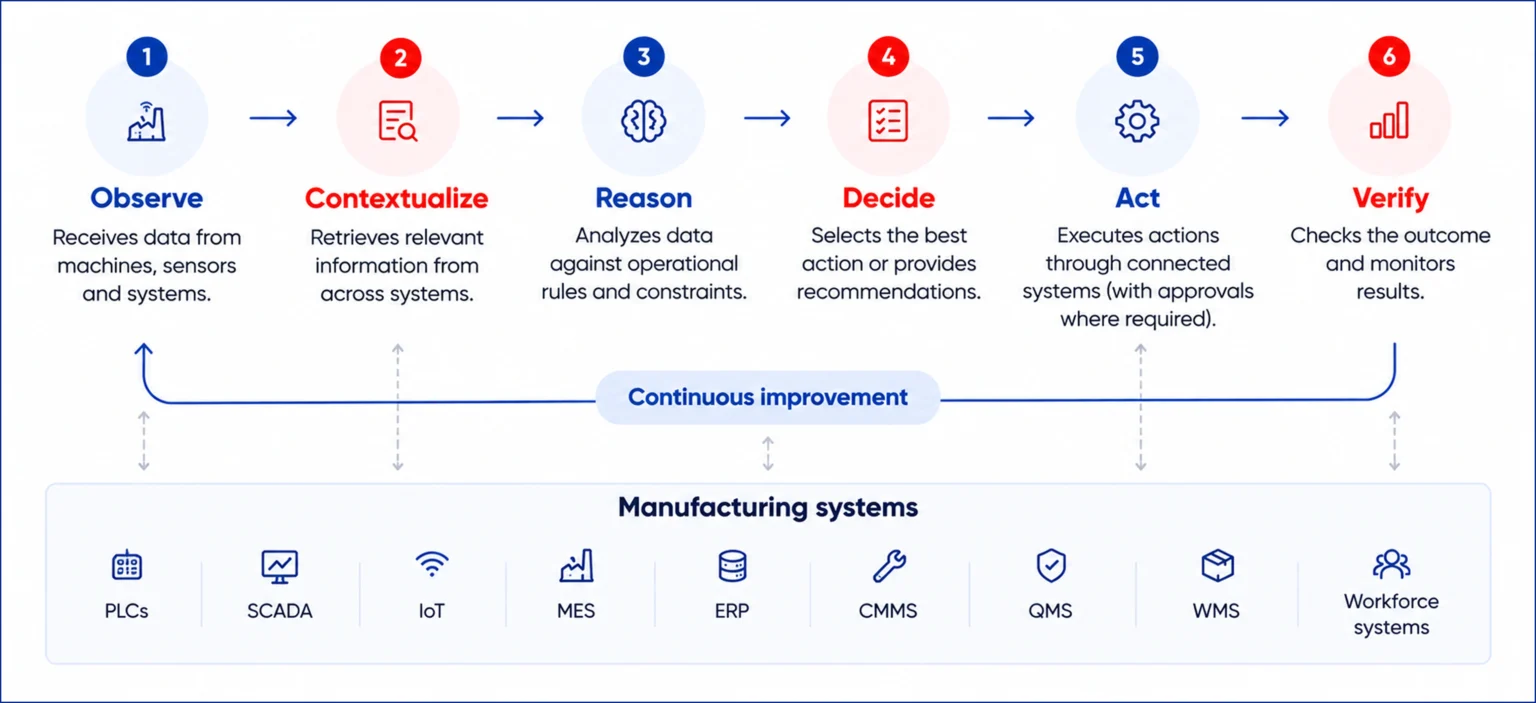
AI agents in manufacturing follow six stages:
Observe → Contextualize → Reason → Decide → Act → Verify
1. Observe
The agent receives information from manufacturing systems.
For example, machine vibration, temperature, production counts, downtime, quality results, inventory levels, and supplier status.
2. Contextualize
The agent retrieves information required to understand the condition.
For a machine failure scenario, this could include:
→ Maintenance history
→ Machine criticality
→ Current production order
→ Spare-part availability
→ Technician availability
→ Alternative machine capacity
→ Customer delivery commitment
3. Reason
The agent evaluates the available information against operational objectives and constraints.
For example:
Which maintenance option minimizes production impact while addressing the highest equipment risk?
4. Decide
The agent selects an action or creates a ranked set of recommendations.
5. Act
Depending on its permissions, the agent can:
→ Create a CMMS work order
→ Update an MES schedule
→ Trigger an ERP procurement action
→ Notify a supervisor
→ Place a quality hold
→ Escalate a supplier risk
6. Verify
The agent checks whether the intended outcome occurred.
For maintenance, this could mean checking:
→ Equipment condition after intervention
→ Downtime duration
→ Production recovery
→ Recurring alarms
→ OEE impact
This closed-loop structure separates an AI agent from a system that simply generates recommendations.
Which Manufacturing Processes are Ready for AI Agents?
Not every manufacturing workflow needs an AI agent.
The strongest candidates are processes where decisions happen frequently, depend on multiple data sources, and lead to a measurable operational action.
| Manufacturing Process | Why It Is a Strong Candidate | Typical AI Agent |
|---|---|---|
| Predictive maintenance | Combines equipment data, maintenance history, and production schedules to prioritize interventions | Maintenance Agent |
| Production scheduling | Schedules change based on machine capacity, materials, labor, and order priorities | Scheduling Agent |
| Quality investigation | Requires analysis of machine, material, production, and quality data to identify root causes | Quality Investigation Agent |
| Inventory management | Inventory decisions depend on demand, consumption, lead times, supplier reliability, and production plans | Inventory Agent |
| Bottleneck management | Production constraints shift with machine availability, WIP, cycle time, and product mix | Operations Agent |
| Supplier risk management | Supplier delays can be evaluated against inventory levels and upcoming production requirements | Supplier Risk Agent |
| Workforce allocation | Operator skills, shift availability, certifications, and production requirements must be matched | Workforce Agent |
| Energy optimization | Energy consumption can be evaluated alongside production schedules and operating conditions | Energy Optimization Agent |
How to Identify an AI Agent Ready Process?
Business impact: Does the problem materially affect downtime, throughput, scrap, labor, inventory, energy, or delivery?
Data readiness: Can the agent reliably access the operational data required to make the decision?
Decision frequency: Does the decision happen frequently enough to create meaningful value from AI assistance?
Decision complexity: Does the decision involve several variables, constraints, or systems?
Actionability: Is there a defined action that can follow the decision?
Operational risk: Can the workflow operate within appropriate permissions, approval steps, and safety controls?
How to Implement AI Agents in a Manufacturing Setup?
With a focused approach, you can integrate AI agents into your manufacturing operations with minimal disruption.
Here’s a clear, step-by-step breakdown of how to make AI agents work for you:
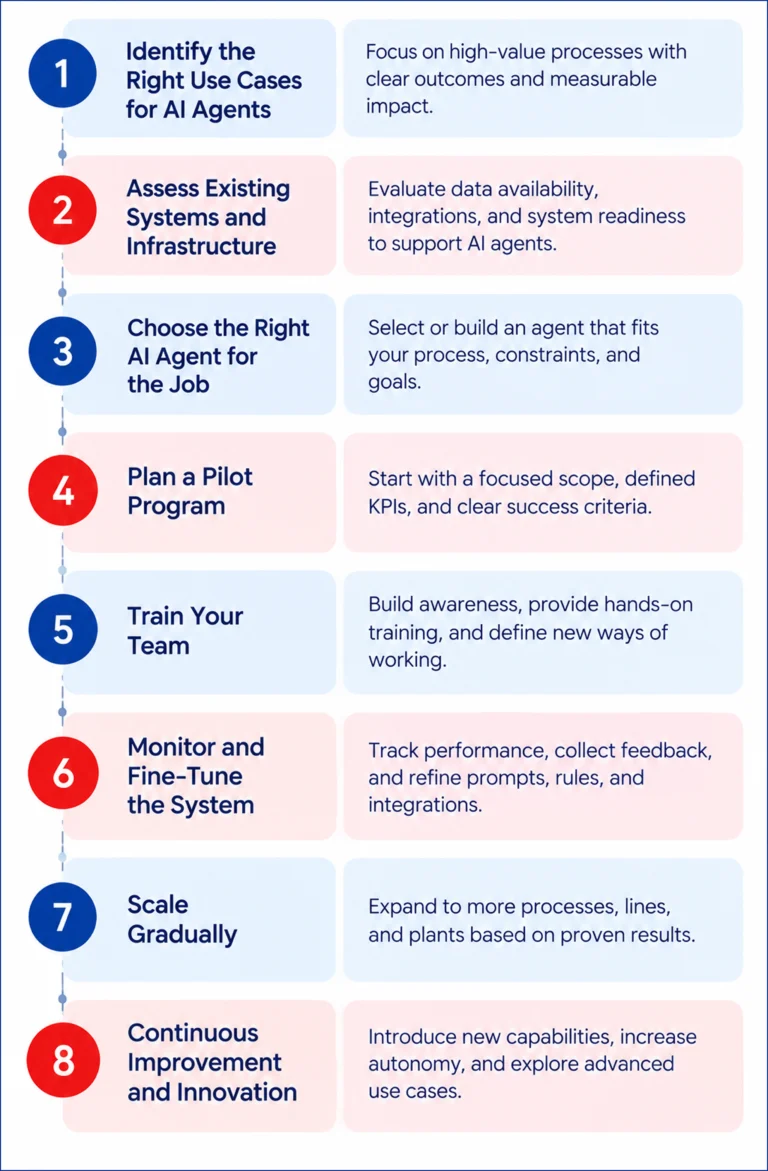
1. Identify the Right Use Cases for AI Agents
The first step is to know exactly where you’ll see the most impact.
Don’t try to automate everything at once. Start by pinpointing areas in your factory where AI agents can solve real problems or optimize processes.
Think of areas where you’re already collecting data, but it’s either underutilized or mismanaged.
2. Assess Existing Systems and Infrastructure
AI agents don’t exist in a vacuum. They need data and connectivity to work.
Before integrating AI, assess your current systems — your ERP, SCADA, and IoT devices. Make sure the data you need is available in real-time.
If your systems are outdated or fragmented, you’ll either need to upgrade them or make adjustments for better integration.
3. Choose the Right AI Agent for the Job
Different AI agents are suited to different tasks.
For predictive maintenance, look for an agent designed to analyze equipment performance and anticipate failures.
For supply chain management, choose an agent that can optimize delivery schedules and manage material flow.
4. Plan a Pilot Program
Start small. Pick one area or machine to test the AI agent on.
A pilot program lets you test how well the AI agent performs in your environment before rolling it out across the entire factory.
For example, you might start by implementing a predictive maintenance AI agent for one production line. After monitoring its performance for a few weeks, evaluate how well it’s helping reduce downtime, improve efficiency, or cut costs.
5. Train Your Team
AI agents might take over some tasks, but they still need human oversight. Your team must understand how to work with AI.
Make sure that everyone is on the same page and that the training is hands-on. Show them exactly how AI agents will benefit them, whether by reducing their workload, preventing machine failures, or streamlining processes.
6. Monitor and Fine-Tune the System
AI agents aren’t “set it and forget it” solutions. They need constant monitoring, particularly in the early stages.
Track their performance, check for any glitches, and keep an eye on how they interact with other systems.
AI agents get better over time, but this improvement depends on the feedback and data they get.
7. Scale Gradually
Bring AI into other areas of the plant, whether it’s improving quality control, optimizing energy usage, or managing inventory.
Don’t rush the scaling process. Gradually introduce AI agents into other workflows to give them time to adapt to new data and environments. A phased approach ensures that you don’t overwhelm your systems or employees.
8. Continuous Improvement and Innovation
As you gain more data and experience with your AI agents, explore new opportunities to expand their capabilities.
Whether it’s by integrating them with new systems, feeding them with more diverse data, or tweaking their decision-making algorithms, the goal should always be continuous improvement.
What Will an AI Agent for Manufacturing Cost to Build and Operate?
The cost of an AI agent in manufacturing depends primarily on the workflow, number of systems involved, data readiness, integration depth, security requirements, and level of autonomy.
For manufacturing, a focused AI agent implementation typically falls in the $80,000–$300,000+ range, while larger multi-agent or multi-plant deployments can require $300,000 to $1 million+ depending on infrastructure, integrations, and scope.
| Manufacturing AI Agent Scope | Typical Investment | What It Usually Includes |
|---|---|---|
| Focused pilot | $80,000–$150,000 | One use case, limited integrations, controlled deployment |
| Production-ready single agent | $150,000–$300,000+ | Multiple data sources, system integrations, monitoring, governance |
| Multi-agent workflow | $300,000+ | Multiple specialized agents, orchestration, cross-functional workflows |
| Enterprise / multi-plant deployment | $500,000–$1M+ | Multiple plants, extensive integrations, centralized governance, scalability |
These ranges are indicative. A predictive maintenance agent using existing IoT and CMMS data can have a very different cost from a production scheduling agent that must coordinate MES, ERP, inventory, workforce, and supplier data.
What Drives the Cost of a Manufacturing AI Agent?
The main cost drivers are:
→ Data readiness: Historical production, equipment, quality, inventory, and maintenance data may require cleansing, normalization, or additional collection.
→ System integrations: Connecting the agent with MES, ERP, SCADA, PLCs, CMMS/EAM, QMS, WMS, or other plant systems increases engineering effort.
→ Agent complexity: A recommendation agent requires less engineering than an agent that plans, executes, verifies, and escalates actions.
→ Autonomy level: More autonomous agents require stronger validation, approval controls, exception handling, and monitoring.
→ Plant infrastructure: Edge gateways, sensors, connectivity, cloud infrastructure, and data pipelines can add to the initial investment.
→ Security and governance: Role-based access, audit trails, action controls, cybersecurity, and compliance requirements add engineering and operational costs.
What Are the Ongoing Operating Costs?
The initial build is only part of the investment. After deployment, manufacturers may need to budget for:
→ LLM or model usage
→ Cloud and compute infrastructure
→ Data and retrieval infrastructure
→ Monitoring and observability
→ Agent evaluation and performance testing
→ Prompt/model updates
→ Integration maintenance
→ Security and access-control maintenance
Azilen’s broader AI Agent Development Cost guide breaks down development costs, component-level investment, monthly operating expenses, and build-vs-buy considerations in greater detail.
How Should Manufacturers Evaluate the AI Agent Investment?
Cost should be evaluated against the value of the specific workflow.
For example, a maintenance agent can be assessed against avoided downtime, maintenance labor, spare-parts usage, and equipment availability. A scheduling agent can be measured through schedule adherence, throughput, changeover time, and capacity utilization.
A useful business case should therefore connect:
AI Agent Investment → Operational KPI → Financial Impact → Expected Payback
Start with one measurable workflow, establish its baseline KPIs, and expand the investment when the agent demonstrates consistent operational value.
ROI of AI Agents in Manufacturing: A Global Study
The latest Google Cloud report, based on a survey of 517 manufacturing leaders, shows that AI technologies, including generative AI and AI agents, are already producing measurable returns across the industry.
For example:
→ 78 % of manufacturing organizations with AI deployments report they’re already seeing ROI from their generative AI efforts, a clear indicator that AI is moving from pilot phase to value realization.
→ 56 % of manufacturing executives say their companies are actively using AI agents, with 37 % deploying more than ten agents across their organizations.
→ 75 % of executives report that generative AI has boosted productivity, both in IT and non-IT functions such as operations planning and maintenance.
For manufacturers in North America with MES, ERP, SCADA, and IoT systems already generating rich operational data, AI agents represent active contributors to measurable KPIs:
→ Reduced downtime due to predictive insights
→ Better production plan adherence through autonomous adjustment
→ Improved quality control consistency via real-time decisioning
→ Faster response to supply chain disruptions with intelligent alerts
When combined with a clear implementation strategy and executive support, these real-world ROI signals greatly strengthen the business case for scaling AI agents in manufacturing from pilot projects into production-critical applications.