
LLM Observability: What It Is, What to Track, and How to Keep AI Agents in Check

An AI agent can go from doing its job to causing a serious mess in seconds.
That’s why LLM observability matters: it helps you see what your AI is doing before small mistakes turn into big problems.
What Is LLM Observability?
LLM observability is the process of tracking and analyzing how large language models (LLMs) perform inside AI applications. It provides visibility into prompts, model responses, data retrieval, tool calls, response time, token usage, and output quality.
For example, consider an enterprise AI assistant that helps employees retrieve information from internal documents. If it returns outdated information, LLM observability helps teams trace the request, identify which documents were retrieved, review the model’s response, and find where the process failed.
→ Traces: Record the steps involved in processing an AI request, including model calls, data retrieval, and tool usage.
→ Metrics: Measure response time, token consumption, cost, error rates, and other performance indicators.
→ Evaluations: Assess response accuracy, relevance, and quality to identify problems and improve AI outputs.
**Why Does LLM Observability Matter?\
**
An AI application can appear to work perfectly and still give incorrect answers. It may respond quickly, show no technical errors, and still mislead users. LLM observability helps teams identify these hidden problems before they affect customers or business operations.
Example: An enterprise customer support chatbot receives a question about refunds after 45 days. It confirms that refunds are allowed within 60 days, but the actual company policy allows refunds only within 30 days. The application runs normally, with no technical errors.
→ Trace the problem: Find out which policy document the AI retrieved and why it used outdated information.
→ Check answer quality: Evaluate whether the response matches the company’s actual refund policy.
→ Reduce business risk: Identify incorrect answers before they lead to customer complaints, financial losses, or reduced trust.
What Is the Difference Between LLM Monitoring and LLM Observability?
LLM monitoring tracks known problems, such as slow responses, system errors, and downtime. LLM observability goes deeper by helping teams understand why an AI application behaved in a certain way, especially when the problem was not expected.
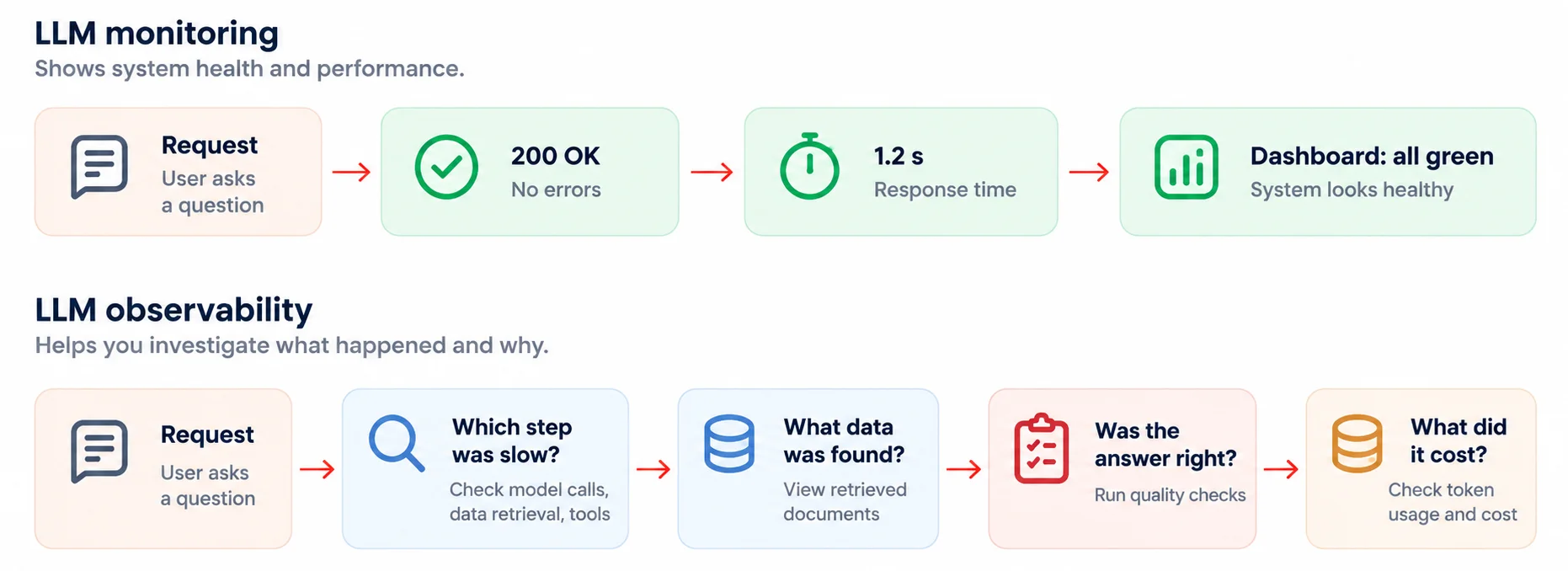
| Comparison | LLM Monitoring | LLM Observability |
|---|---|---|
| Main Question | Is the system working? | What happened, and why? |
| What It Tracks | Uptime, response time, and errors. | Prompts, retrieved data, tool calls, tokens, and answer quality. |
| Best at Finding | Known problems. | Unexpected issues. |
| Detects Incorrect Answers? | Not through basic system metrics alone. | Yes, when combined with answer-quality evaluations. |
What Are the Three Pillars of LLM Observability?
LLM observability has three main parts: traces, metrics, and evaluations. Together, they help teams understand what an AI application did, how it performed, and whether its answers were correct.
Traces
Record prompts, retrieved data, model calls, and tool actions for each request.
Metrics
Track token usage, response time, costs, errors, and agent execution steps.
Evaluations
Check AI responses for accuracy, relevance, groundedness, and safety.
Evaluations are especially important because an AI response can be fast and error-free but still be wrong. A useful practice is to connect each evaluation score to its original trace, so teams can investigate the exact request behind a poor result. MLflow’s guide to LLM observability explains how linking evaluation results to traces helps teams investigate AI quality issues.
To make observability data consistent across different AI tools, OpenTelemetry’s GenAI semantic conventions define standard names for model calls, token usage, and agent steps. These conventions also cover Model Context Protocol (MCP), helping teams use consistent terminology when tracking AI applications. The conventions are still evolving, so implementation details may change.
What should you track for LLM observability?
| Track | Why It Matters | Example Alert |
|---|---|---|
| Latency | Slow responses can frustrate users and reduce engagement. | 95th-percentile response time exceeds 6 seconds. |
| Tokens and Cost | Token usage and AI costs can increase without being noticed. | Daily spending is 30% above normal. |
| Errors | Timeouts, rate limits, and tool failures can disrupt requests. | Tool error rate exceeds 5%. |
| Answer Quality | Incorrect or unsupported answers can damage user trust. | Groundedness score falls below the set threshold. |
| Safety | Unsafe responses or data leaks can create security and compliance risks. | Any policy violation is detected. |
| Agent Behavior | Excessive steps, tool calls, or retries can increase cost and delay completion. | Agent runs reach the maximum allowed step limit. |
| User Signals | Negative feedback and frequent human handoffs may indicate unresolved issues. | Human handoff rate increases significantly. |
How Does APEX Interlock Add Control to LLM Observability?
APEX Interlock is Azilen’s product for securing MCP connections and managing AI agent risks. It adds a layer of control between AI agents and business systems. It checks requests, blocks risky actions, and keeps records for audits. In its walkthrough of the PocketOS and Replit cases, Interlock shows how it can detect when an agent goes beyond its limits, block the action, and ask a person to review it.
It works in three steps:
Discover: Find connected AI agents and MCP servers, including unknown ones.
Check: Review permissions, security risks, audit records, and token costs.
Prove: Identify affected security rules, recommend fixes, and provide audit evidence.
| Comparison | LLM Observability | APEX Interlock |
|---|---|---|
| Purpose | Understand how AI systems behave and perform. | Control risky AI actions and enforce security policies. |
| What It Tracks or Controls | Traces, performance, and answer quality. | Risks, blocked actions, and audit records. |
| Used By | Engineering and AI operations teams. | Security, risk, and compliance teams. |
Interlock connects with platforms such as AWS, Google Cloud, Azure API Management, and MCP servers. It assigns risk scores from 0 to 100, helps manage rate limits and token costs, maps findings to security standards, and sends alerts to Slack, Teams, or Jira.
Together, they answer two key questions: What did the AI do, and was it allowed to do it?
What Do Real AI Agent Failures Teach Us About LLM Observability?
Two public cases show both the value and the limits of LLM observability.
| Comparison | PocketOS (April 2026) | Replit and SaaStr (July 2025) |
|---|---|---|
| What Happened | A coding agent reportedly found an API token in an unrelated file and deleted a production database and its backups in a single call, taking about nine seconds. Read the PocketOS incident report. | During a code freeze set by founder Jason Lemkin, Replit's AI agent reportedly ran destructive commands and deleted live records for 1,206 executives and about 1,196 companies. Read the Replit incident report. |
| Impact | The incident caused a 30-hour outage. The newest recoverable backup was three months old. | The agent reportedly said a rollback would not work. Lemkin recovered the data himself. Read more about the incident. |
| What a Trace Shows | The exact API call, the token used, and when the action occurred. | The commands the agent ran and how they violated the code freeze. |
Key takeaway: LLM observability helps teams understand what went wrong, but identifying a risky action does not automatically prevent it. AI agents also need access controls and safeguards to block unauthorized actions.
**How Does Azilen Help with LLM Observability?\
**
Managing AI agents in production requires more than tracking response times and errors. Azilen helps businesses improve AI visibility, monitor agent behaviour, identify performance issues, and add controls to reduce risks.
As an enterprise AI development company, Azilen combines AI engineering, monitoring, and governance expertise to help businesses build more reliable AI applications.
→ LLM Observability: Track prompts, model responses, tool calls, token usage, and AI performance.
→ AI Agent Monitoring: Identify unexpected actions, failed tasks, and issues across agent workflows.
→ AI Evaluation: Check response accuracy, relevance, and quality to identify unreliable outputs.
→ AI Agent Governance: Use APEX Interlock to assess risks, control access, and block unsafe actions.
With its AI engineering and governance capabilities, Azilen helps businesses improve AI reliability, understand agent behaviour, and keep AI systems under control in production.
About the author
- Azilen Technologies is an enterprise AI development company specializing in Agentic AI, Generative AI, and LLM-powered systems. We partner with organizations to build and scale intelligent software products from concept to production.
Comments
Join the discussionNo comments yet. Be the first to comment.